
Please show up more authentically.
Your team probably wants more of your quirky, honest, weird, human voice.

I promise Claude did not write this newsletter.
But it totally could. Which is why I think that now more than ever people are craving authenticity from their leaders.
We see it in politics (👋 Mamdani, Platner, AOC, Trump). Love them or hate them, unfiltered voices break through.
And your team probably wants you to show up more authentically, too.
People have always been skeptical of corporate gobbledygook:
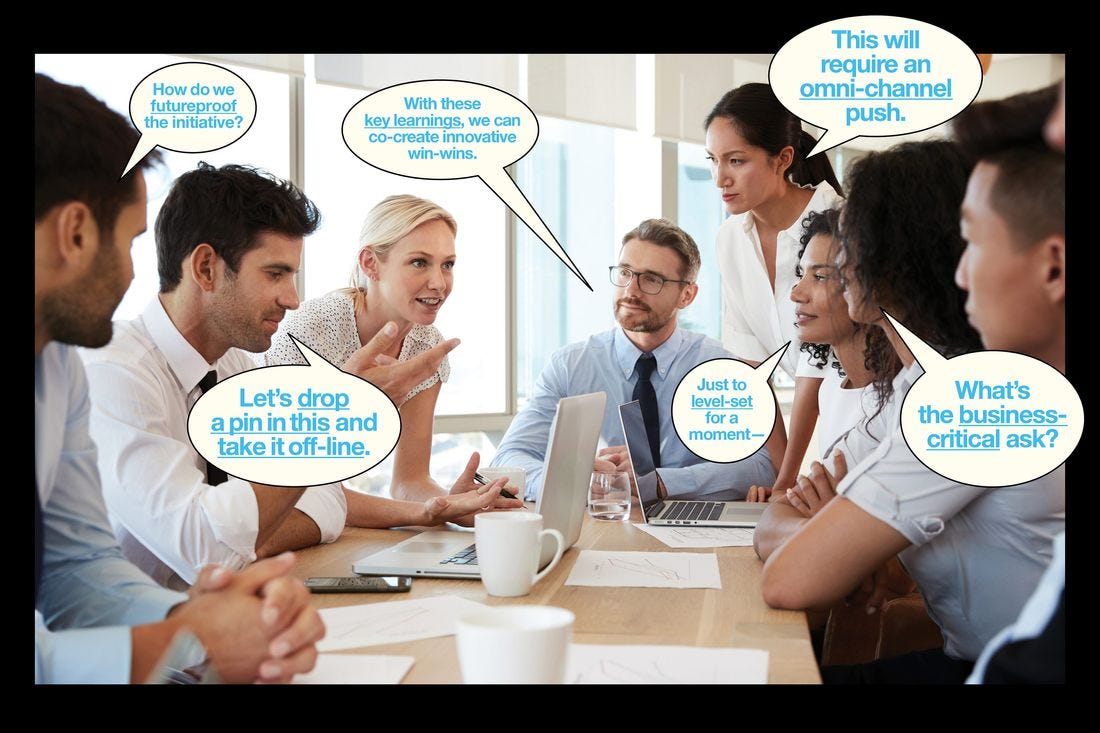
But in this “new world of AI” (a corporate buzz-phrase, I know), BS becomes more obvious and less tolerable than ever before. People are already skeptical that a robot wrote the company update or planned the agenda for your meeting. Don’t give them an excuse to distrust or dismiss you!!! In a world of “synergies” and “key stakeholders,” be a human being.
Showing up authentically is about more than just removing em dashes. (RIP to my favorite punctuation mark. I miss you every day.)
Here are some of the questions, frameworks, and strategies I use with leaders to help them dial up their authenticity.
Get feedback.
Very few leaders think they show up inauthentically. Which is why it’s so important to get feedback. If you’re working with a coach already, great! Encourage them to incorporate authenticity into your 360 feedback process. If you’re not already undergoing a feedback process…ask people on your team! I like the question: “On a scale of 1 - 10, how authentic am I? What’s something that could bring your score up just one point?” Or “When’s the last time I showed up really authentically? Why?”
Audit your time and budget.
If there’s a disconnect between your stated and lived values, you’ll reek of inauthenticity. For example, if you say “This team’s growth and development is the most important thing to me” but then spend $0 and 20 minutes on team development, you’ll lose trust. Ask yourself “What do I say I value? And then where does my calendar, attention, and money actually go?” If there’s a gap, close it (by either changing how you talk or changing what you do).
Be more specific.
The antidote to generic, overly polished communication is specificity. Specific examples, specific language, specific opinions. Leaders who speak in generalities lose trust. A simple check: Could this sentence have been written by anyone, or be about any company or team? If yes, rewrite it. Suddenly “we’re collaborative and innovative” (boo) becomes “last week our customer service team worked with our distribution team to send a handwritten note to a customer who just placed their 100th order” (interesting! and adorable).
Tell it to a 6th grader.
If you’re not speaking in clear, simple terms that a 6th grader could understand, you might be full of s*@$. Take this example from Microsoft CEO Satya Nadella:
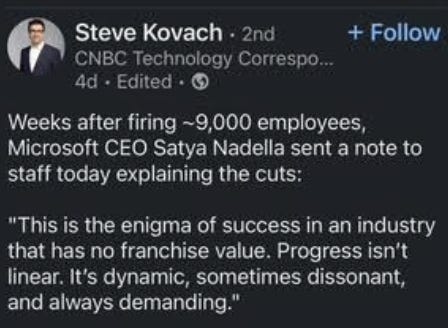
What in the corporate nonsense is he talking about? Simplify. Use real words. And when in doubt seek feedback from your favorite 12 year old.
“What do I actually think?”
Before a meeting, presentation, or communication, ask yourself “What do I actually think about this?” Not What am I supposed to think? or What will go over well with my team? Then make sure that what you actually believe is coming through. This is a simple, daily practice for building more authenticity.
The “reasonable disagreer” gut-check.
Could a reasonable person disagree with your POV or approach? If no one is saying “That’s a weird way of putting it” or “I personally wouldn’t be so [whatever]”, then you might be too blah. My favorite example here is that when I was their Chief of Staff Jeff and Andy, the CEOs of Mammoth Brands, ended an important all-company email with the line: “Buckle the f&#* up.” Plenty of people might have argued it was totally inappropriate. But it was so them, which made it perfect.
Tell stories with a cost.
Generic stories ("I learned so much from failure!") feel hollow because they've been sanitized, and as a result don’t really say anything. Authentic stories have something specific at stake. A real mistake, an actual cost, a moment of genuine uncertainty. We don’t want to hear you’ve learned from failure, we want you to be honest about the time you messed up a mail merge and pissed off a bunch of reporters back when you were working in PR (hypothetically…lol…) The detail that makes you uncomfortable to share is usually the detail that makes people trust you. Don’t tell people about how your biggest area for development is that you’re too perfect. Share a real cost.
The good news is that none of this requires you to be someone you're not. In fact, it just requires you to be more of who you actually are. Which, in my experience, is a lot more interesting.
💯
Grateful for this and you and your authenticity.